
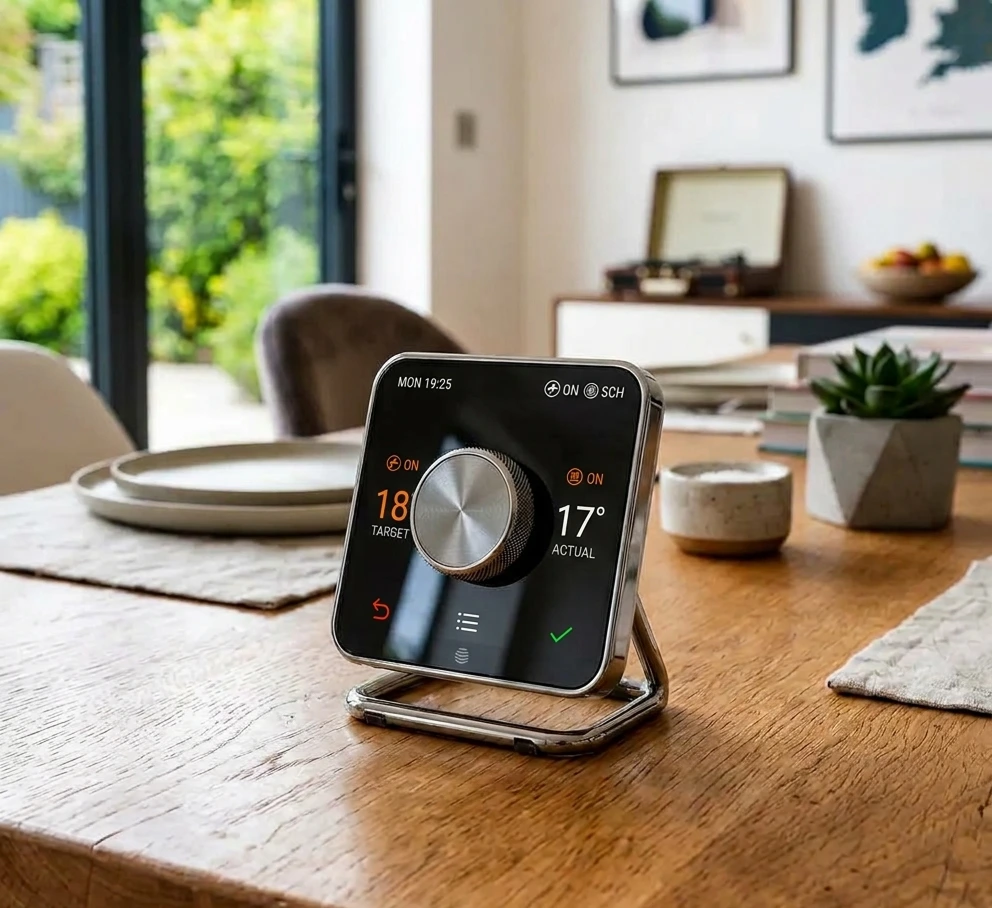
Replacing a combi boiler does not necessarily mean replacing every component of your heating controls. Your existing thermostat may be perfectly suitable for the new appliance, but compatibility should always be checked before installation rather than assumed.
Thermostats and wireless receivers communicate with the boiler in different ways. A control system that worked with an older appliance may not provide the same functionality with a replacement model. Understanding this before arranging a new combi boiler Chesterfield installation can help avoid unexpected changes and ensure the heating system works as intended.
If you are planning to replace your combi boiler, APH can assess your existing thermostat and receiver as part of the installation requirements. Contact our team for advice tailored to your current heating system.
Can an existing thermostat work with a new combi boiler?
Yes, an existing thermostat can sometimes be retained when a combi boiler is replaced. However, this depends on the specific thermostat, receiver, wiring arrangement and replacement boiler.
A basic thermostat may use a straightforward electrical switching signal to tell the boiler when heat is required. Other controls can communicate with compatible boilers in a more sophisticated way, allowing the appliance to adjust its output according to the heating demand.
The fact that the old thermostat is currently working does not automatically confirm that it is the right control for the new boiler.
Why does thermostat compatibility matter?
The thermostat is an important part of the heating system because it determines when the property needs heat. If communication between the thermostat and boiler is unreliable or incompatible, the heating may not respond correctly.
Compatibility can affect:
- Whether the boiler receives a heating demand.
- Whether the wireless receiver can communicate with the thermostat.
- How the boiler responds to changes in room temperature.
- Whether advanced control functions are available.
- How the heating system is configured and commissioned.
- Whether additional equipment is needed during installation.
A replacement boiler should therefore be considered as part of the complete heating system, rather than as an isolated appliance.
What types of thermostat might be found in an existing system?
Homes can have several different types of heating control. The appearance of the thermostat does not necessarily tell you how it communicates with the boiler.
Common arrangements include:
| Thermostat type | Typical arrangement | Compatibility consideration |
| Wired room thermostat | Connected by cable | Existing wiring and boiler terminals need checking |
| Wireless thermostat | Communicates with a receiver | Receiver and boiler connection need checking |
| Programmable thermostat | Provides scheduled heating | Control protocol and boiler compatibility matter |
| Modulating thermostat | Can vary demand rather than simply switch on/off | Must be compatible with the boiler |
| Older mechanical control | Basic temperature switching | May have limited functionality with modern systems |
An installer should identify the exact equipment and connection method before deciding whether it can be retained.
Does a wireless receiver need to be replaced too?
Not always. The receiver may be suitable for the replacement boiler, but this needs to be confirmed.
A wireless thermostat normally communicates with its receiver rather than directly with the boiler. The receiver is then wired into the heating system.
If the replacement boiler uses a different connection arrangement, the receiver may need to be changed. Even when the receiver can technically operate the new appliance, the available control functions may differ from those offered by a newer compatible system.
For this reason, the receiver should be checked during the planning stage of combi boiler installation in Chesterfield, not left until the day of installation.
What should an installer check before reusing your thermostat?
There are several practical checks that can be completed during a survey or installation assessment.
1. Identify the thermostat
The make and model can provide information about its communication method and compatibility.
2. Identify the receiver
For wireless systems, the receiver should be located and inspected. Its wiring and connection to the heating system should also be considered.
3. Establish how the existing boiler is controlled
The installer can determine whether the current setup uses simple switching, a communicating control system or another arrangement.
4. Check the proposed boiler
The replacement appliance has its own control requirements and compatible accessories. These should be considered before the installation is specified.
5. Confirm the homeowner’s preferred controls
A homeowner may want to retain the existing thermostat for simplicity, while another may prefer to upgrade to a newer programmable or modulating control.
6. Test the finished installation
After the boiler and controls have been installed, the system should be tested to confirm that heating demand is communicated correctly.
Could keeping an old thermostat affect how the new boiler operates?
Potentially. An existing thermostat may allow the new boiler to operate, but it may not make use of every control feature available from the replacement appliance.
For example, a basic on/off control can generally tell the boiler whether heat is required. A compatible advanced control may provide more detailed information about the heating demand.
This does not mean that every homeowner needs the most advanced thermostat available. The appropriate control depends on the boiler, property and heating requirements.
The important point is to understand what the chosen control system can actually do.
APH can explain the differences between retaining existing controls and upgrading them as part of a boiler replacement. Speak to us if you want to understand what would be appropriate for your property before installation begins.
When might replacing the thermostat make sense?
Replacing the thermostat can be sensible in several situations.
For example, the existing unit may be:
- Incompatible with the replacement boiler.
- Damaged or unreliable.
- Difficult to programme.
- Based on an older control system.
- Missing features that are useful with the new appliance.
- Connected to an unsuitable or outdated receiver.
However, replacement should be based on the requirements of the heating system rather than simply the age of the thermostat.
A relatively old thermostat that is compatible, reliable and suitable for the homeowner’s needs may not need changing.
Does replacing the boiler mean the thermostat has to be moved?
Usually not. The physical location of the thermostat can often remain unchanged if it is appropriately positioned.
However, location matters. A thermostat should measure representative room temperature. It should not normally be positioned somewhere that is unusually affected by direct sunlight, draughts, heat-producing appliances or other local temperature sources.
If a new control is being installed, the installer may assess whether the existing location is suitable.
Wireless controls can provide greater flexibility because they do not require the thermostat itself to be connected to the boiler by a dedicated cable. The receiver still requires an appropriate connection to the heating system.
What if the thermostat works but the boiler does not respond?
This situation does not automatically mean that the new boiler has failed.
The fault could involve:
- The thermostat’s heating demand.
- Wireless communication.
- Receiver pairing.
- Receiver power supply.
- Receiver wiring.
- Boiler control terminals.
- Boiler configuration.
- Another heating-system component.
The correct response is to diagnose the communication chain from the thermostat through to the boiler.
This is particularly important shortly after a replacement because it can be tempting to assume that any problem must have been caused by the new appliance.
A typical replacement scenario
Imagine a Chesterfield property with an older combi boiler and a wireless programmable thermostat. The thermostat has worked reliably for several years, and the homeowner would prefer to keep it when upgrading the boiler.
During the installation assessment, the engineer identifies the thermostat and separate receiver. The proposed replacement boiler is then checked against the existing control arrangement.
The assessment establishes whether the existing equipment can be retained and what functionality will be available. If the controls are unsuitable, the homeowner can be told about the alternatives before the installation takes place.
This gives the homeowner a clear choice rather than discovering a compatibility issue halfway through the work.
What should be included when planning a new combi boiler installation?
A proper installation plan should cover more than the appliance itself.
When discussing a new combi boiler Chesterfield project, it can be useful to confirm:
- Which boiler is being proposed.
- Whether the existing thermostat will remain.
- Whether the wireless receiver will remain.
- Whether new controls are recommended.
- Whether control upgrades are included in the quotation.
- Whether additional wiring is required.
- How the controls will be tested after installation.
- What documentation will be provided when the work is completed.
These details can make quotations easier to understand and reduce the likelihood of unexpected changes.
Are advanced controls always necessary?
No. More sophisticated controls are not automatically the right choice for every household.
A homeowner may prefer a simple thermostat because it is easy to operate. Another household may benefit from more detailed scheduling or a control system designed to communicate more effectively with the chosen boiler.
The installer should explain the available options and any compatibility requirements. The final choice should reflect the boiler specification, property and homeowner’s preferences.
Frequently Asked Questions
Can I keep my existing thermostat with a new combi boiler?
Possibly. Compatibility depends on the thermostat, receiver, wiring and replacement boiler. These should be checked before the installation is confirmed.
Does a wireless thermostat work with all combi boilers?
No. Wireless thermostats and receivers are not universally compatible. The specific control equipment and boiler connection should be checked by an installer.
Will a new combi boiler always need a new receiver?
No. An existing receiver may be suitable, but its compatibility and wiring should be checked before it is reused.
Is it better to replace an old thermostat during boiler installation?
Not necessarily. Replacement may be appropriate if the thermostat is incompatible, unreliable or unsuitable for the new system. A compatible existing control may be retained.
Can APH check my thermostat before installing a new boiler?
Yes. The thermostat, receiver and existing control arrangement can be assessed alongside the proposed boiler so that compatibility requirements are understood before installation.
Combi Boiler Replacement in Chesterfield: Can You Keep Your Existing Thermostat?
Your thermostat does not automatically need replacing when you install a new combi boiler. In some cases, existing controls can continue to provide reliable operation. In others, the receiver, thermostat or control arrangement may need to be changed to suit the replacement appliance.
Checking these details before new combi boiler Chesterfield work begins can help prevent communication problems and make the final installation easier to understand.
APH considers the boiler and heating controls together, helping homeowners understand what can be retained, what may need changing and how the completed system should operate.
If you are considering a combi boiler replacement and want to know whether your existing thermostat can stay, contact APH for professional guidance and a tailored quotation.