
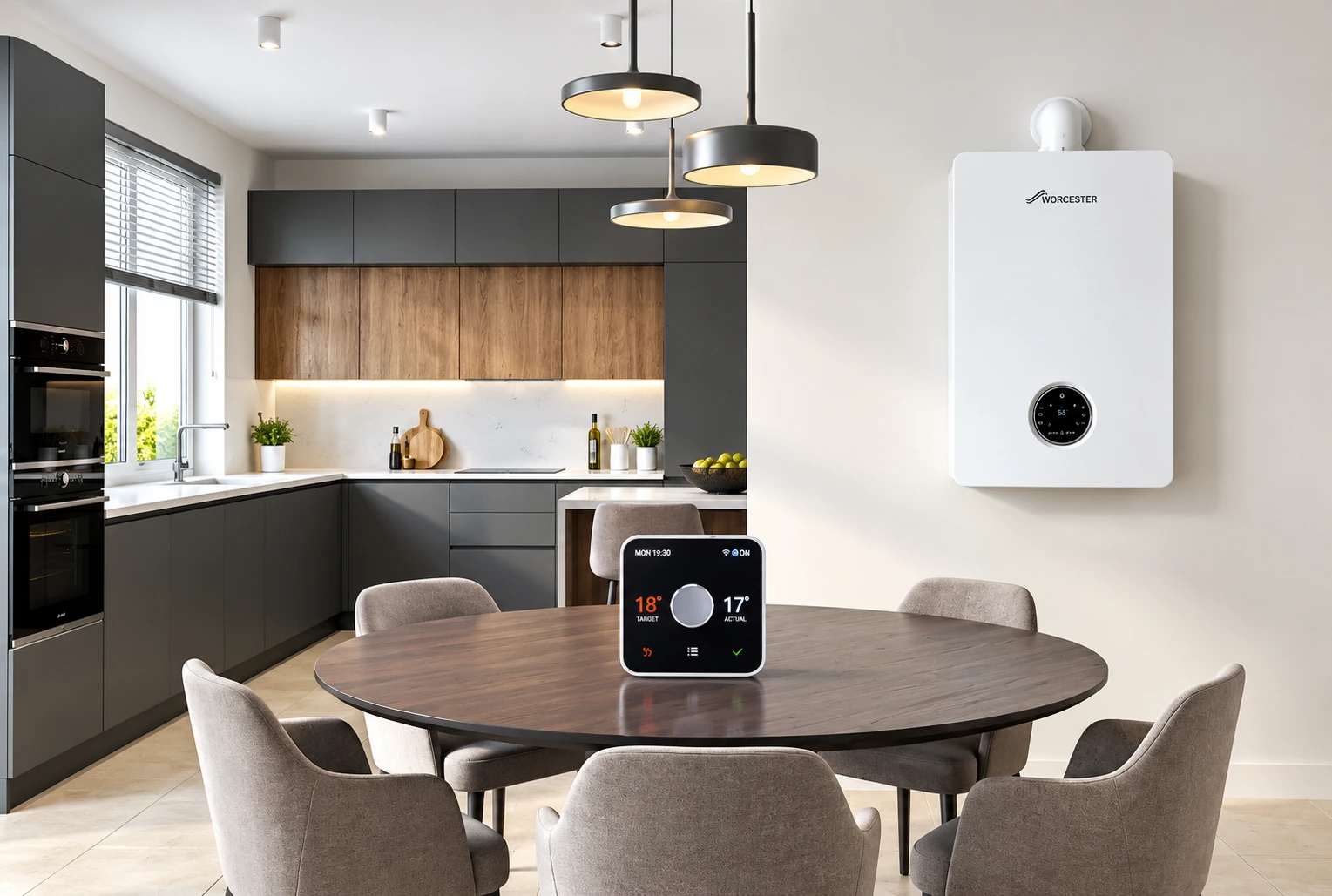
A gas boiler may be the most recognisable part of a central heating system, but it does not work in isolation. The thermostat, receiver, electrical connections and control configuration all influence whether the boiler receives the correct instruction to provide heating.
This becomes particularly important when replacing an existing appliance. During gas boiler installation in Chesterfield, an installer should consider how the proposed boiler will communicate with the property’s existing or new heating controls.
Checking these connections before installation can help prevent avoidable communication faults and make the final system easier to operate.
If you are planning a replacement boiler, APH can assess the boiler and heating controls together. Contact our team if you would like professional guidance on the requirements for your installation.
What is the communication path between the thermostat and boiler?
The exact arrangement varies between heating systems, but a typical wireless setup follows a straightforward sequence:
Thermostat → Wireless signal → Receiver → Wired connection → Boiler
The thermostat measures the room temperature and determines whether there is a demand for heat. It sends that demand to the receiver, which is connected to the heating system.
The boiler then responds according to its control settings and operating requirements.
With a wired thermostat, the arrangement may be different because the thermostat itself is connected directly through wiring rather than communicating wirelessly with a separate receiver.
Understanding which arrangement is present is one of the first steps in assessing the system.
Why should controls be checked before installing a new gas boiler?
A replacement boiler may have different control requirements from the appliance being removed.
An existing thermostat may be compatible, partially compatible or unsuitable for the proposed system. The same applies to a wireless receiver.
If the controls are not assessed before installation, potential issues may not become apparent until the new boiler is fitted.
A proper survey can establish:
- What thermostat is currently installed.
- Whether the system uses a wireless receiver.
- How the receiver connects to the boiler.
- What type of control signal is being used.
- Whether the existing controls can be retained.
- Whether replacement controls are appropriate.
- Whether additional wiring or electrical work is required.
This information can then be incorporated into the installation plan.
Which parts of the control system should an installer inspect?
The inspection should cover the complete route from the homeowner’s heating demand to the boiler.
| Component | What should be considered? | Potential issue |
| Thermostat | Model, condition and control method | Incompatibility or faulty demand |
| Wireless receiver | Power, pairing and wiring | Lost communication or receiver failure |
| Control wiring | Connections and condition | Broken, loose or unsuitable connections |
| Boiler terminals | Correct control connection | Incorrect configuration |
| Control settings | Boiler and thermostat configuration | System may not respond as expected |
| Final operation | Heating demand and boiler response | Confirms the system works together |
Not every installation requires changes to all these components. The purpose of the checks is to identify what is actually needed.
Can an existing wireless receiver be used with a new boiler?
Sometimes, but compatibility must be confirmed.
A receiver is not simply a universal wireless adapter. Its connection to the boiler and communication with the thermostat both need to be suitable for the proposed system.
There may also be a difference between basic switching controls and more advanced communicating controls. A receiver that can switch a boiler on and off may not provide all the functionality supported by another control arrangement.
For a homeowner considering gas boiler installation in Chesterfield, this distinction is worth discussing before selecting the final specification.
What happens if the thermostat and receiver are compatible but the wiring is not?
The wireless communication between the thermostat and receiver can be working correctly while the connection between the receiver and boiler has a problem.
For example, the receiver may indicate that it has received a heating demand, but the boiler may not respond because of an issue with the connection between the two components.
This is why testing only the thermostat is not enough.
An installer should consider the complete communication path and confirm that the boiler responds appropriately when a heating demand is generated.
Does the boiler manufacturer affect control compatibility?
Yes. Different boiler manufacturers and models can have specific control requirements and compatible control options.
Some systems may support advanced controls that can communicate more closely with the boiler. Others may be controlled through more straightforward switching arrangements.
The installer should therefore consider the exact boiler model rather than making a general assumption about all boilers.
When choosing a gas boiler installation company, homeowners can reasonably ask how the existing thermostat and receiver will be assessed and whether compatible controls are included in the proposed installation.
APH can discuss the control options alongside the proposed boiler, helping you understand whether existing equipment can remain or whether changes are recommended.
What should happen during commissioning?
Installation is not complete simply because the boiler starts.
Commissioning should include appropriate checks to confirm that the appliance and controls are operating correctly.
Depending on the system, this can involve:
- Checking the thermostat’s heating demand.
- Confirming the wireless receiver responds.
- Checking the receiver-to-boiler connection.
- Testing the boiler’s response.
- Checking programmed operation where applicable.
- Confirming the system operates correctly after adjustments.
- Providing the homeowner with relevant instructions.
This final testing is particularly valuable because a communication fault may not be obvious from the boiler display alone.
Can poor control wiring cause intermittent heating?
It can. If a connection is loose, damaged or otherwise unsuitable, the heating demand may not be transmitted reliably.
Intermittent faults can be particularly frustrating because the system may work normally at one time and fail later.
Symptoms can include:
- Heating starting unexpectedly.
- Heating failing to start.
- The boiler responding only occasionally.
- A receiver appearing to respond inconsistently.
- Heating returning after the controls are adjusted or restarted.
These symptoms should be investigated rather than repeatedly reset.
What should be included in a boiler installation quotation?
The quotation should make the scope of work reasonably clear.
If the existing thermostat and receiver are being retained, that can be confirmed. If new controls are needed, the quotation should identify them and explain whether installation is included.
Useful details include:
- Boiler model and specification.
- Removal of the existing boiler.
- New thermostat, if required.
- New wireless receiver, if required.
- Control wiring or electrical work.
- System preparation.
- Testing and commissioning.
- Guarantees and warranties.
- Any exclusions or additional works.
This makes it easier to compare quotations on a like-for-like basis.
A typical Chesterfield installation example
Consider a homeowner replacing an older gas boiler with a modern combi boiler. The existing heating system uses a wireless thermostat and separate receiver.
During the survey, the installer identifies both control units and checks how the receiver connects to the existing appliance. The proposed boiler is then assessed against the existing arrangement.
The installer establishes that the thermostat can be retained but that the receiver needs to be changed to provide the appropriate connection to the replacement boiler.
Because this is identified before the installation, the homeowner knows what is included in the quotation and the new control arrangement can be tested as part of commissioning.
Should homeowners replace all heating controls with the boiler?
Not necessarily.
There is no general requirement to replace every control whenever a boiler is changed. If existing equipment is compatible, reliable and suitable for the proposed system, it may be possible to retain it.
On the other hand, replacing controls may be appropriate where:
- The existing equipment is incompatible.
- The controls are unreliable.
- The receiver is no longer suitable.
- The homeowner wants improved functionality.
- The new boiler supports a control arrangement that the old system cannot provide.
The recommendation should be based on the actual heating system rather than a blanket rule.
How can homeowners reduce the risk of communication faults?
The best opportunity to address compatibility is before installation begins.
A homeowner can help by providing the installer with information about the existing thermostat and receiver and explaining any problems that have occurred previously.
It is also useful to ask:
- Will my existing thermostat work with the new boiler?
- Can the receiver be retained?
- Are new controls included in the quotation?
- Is any additional wiring required?
- Will the controls be tested after installation?
- What should I do if the heating does not respond correctly?
These questions can make the installation plan much clearer.
Frequently Asked Questions
Does a new gas boiler need a new thermostat?
No. An existing thermostat may be suitable if it is compatible with the replacement boiler and control arrangement. The installer should check this before deciding whether replacement is necessary.
Does the receiver need checking during boiler installation?
Yes. If the system uses a wireless thermostat, the receiver forms an important part of the communication chain. Its compatibility, power supply, pairing and wiring should be considered.
Why does my thermostat work but the new boiler not respond?
The issue could be with the receiver, wiring, boiler connection or configuration. The complete communication path should be tested rather than assuming the thermostat is faulty.
Should control changes appear on my boiler quotation?
Yes. If new controls, a receiver or associated wiring are required, these should be clearly identified so you understand what the quoted installation includes.
Can APH check my existing heating controls?
Yes. APH can assess the existing thermostat and receiver alongside the proposed boiler to determine what can be retained and what may need changing.
Planning a Boiler Installation in Chesterfield? Get Expert Advice on Heating Controls
The boiler is only one part of a modern heating system. The thermostat, wireless receiver and connections between them all need to communicate correctly for the heating to respond as expected.
During gas boiler installation in Chesterfield, checking these components before work begins can help identify compatibility issues, clarify the installation specification and reduce the likelihood of control faults after commissioning.
APH takes a complete-system approach, considering the appliance and its controls together rather than treating the thermostat and receiver as separate afterthoughts.
If you are planning a gas boiler replacement and want clarity on your thermostat, receiver or control requirements, contact APH for expert advice and a tailored installation quotation.