
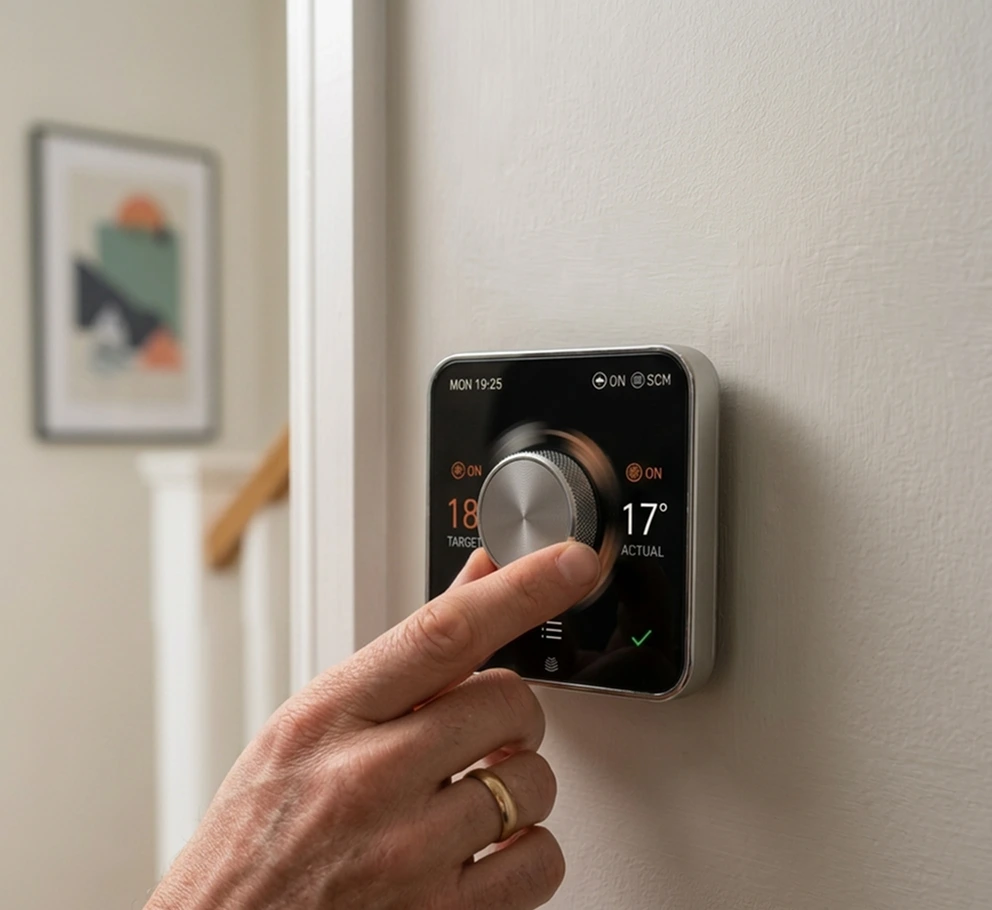
You turn up the thermostat, wait for the familiar sound of the heating starting, and nothing happens. The thermostat appears to be requesting heat, but the boiler remains quiet. It is natural to assume that the appliance has developed a serious fault.
However, the thermostat is only one part of the communication chain. With a wireless system, the thermostat sends a signal to a receiver, which then communicates with the boiler. A fault anywhere along that route can prevent the heating from responding.
Understanding the possible causes can help you describe the problem accurately and avoid assuming that the boiler itself needs replacing.
If your thermostat is calling for heat but the boiler is not responding, APH can assess the complete control system. Contact our team for professional diagnosis before arranging unnecessary replacement work.
Why might the boiler ignore a heating demand?
A thermostat calling for heat does not necessarily mean that the boiler has received the instruction.
In a typical wireless setup, the sequence is:
Thermostat detects a need for heat → Wireless signal is sent → Receiver receives the signal → Receiver communicates with boiler → Boiler responds
If communication breaks down at any stage, the heating may remain off.
Possible causes include a thermostat problem, depleted batteries, loss of wireless pairing, a receiver fault, an electrical connection issue or a fault within the boiler itself.
The symptoms can be very similar, which is why proper diagnosis matters.
What should you check before assuming the boiler has failed?
There are a few basic observations that can help establish what is happening.
Start by checking whether:
- The thermostat display is active.
- The thermostat is set above the current room temperature.
- The thermostat is showing a heating demand.
- The receiver has power.
- The receiver’s indicators appear normal.
- The boiler display is operating.
- The boiler shows a fault code.
- Hot water is still working if the property has a combi boiler.
These checks do not replace professional diagnosis, but they can provide useful information for the engineer.
Do not remove boiler covers or attempt to interfere with gas or electrical components yourself.
Could thermostat batteries cause the problem?
Yes. Many wireless thermostats rely on batteries, and a low battery can affect their ability to communicate reliably.
Depending on the thermostat, warning signs might include a low-battery symbol, a dim display or unusual behaviour. However, not every fault is obvious from the screen.
If replacing the batteries does not restore heating operation, the problem may lie elsewhere in the communication chain.
A receiver can also have its own power supply and wiring. Therefore, a working thermostat display does not prove that the receiver is receiving or passing on the heating demand.
What does the wireless receiver actually do?
The receiver acts as the link between the wireless thermostat and the heating system.
The thermostat is normally located in a suitable room where it can measure the property’s temperature. The receiver is positioned elsewhere and connected to the heating controls or boiler.
When the thermostat requests heat, the receiver should respond and pass the appropriate signal to the heating system.
A receiver fault can therefore produce a situation where:
| What the homeowner sees | What may be happening |
| Thermostat shows heating demand | Thermostat is requesting heat |
| Receiver appears inactive | Signal may not be reaching or activating the receiver |
| Boiler remains off | No effective heating demand may be reaching it |
| Hot water still works | Boiler itself may still have power and functionality |
| Heating works intermittently | Communication or another component may be unreliable |
These symptoms are clues rather than proof. A qualified engineer needs to test the individual components.
Can a receiver lose communication with the thermostat?
Yes. Wireless thermostats and receivers may need to be paired so that they recognise each other. If that connection is lost or disrupted, the thermostat can appear to operate normally while the receiver does not respond.
The cause can vary. Equipment may have lost its pairing, a component may have developed a fault, or there may be an issue with power or the wireless communication itself.
An engineer can check the equipment and determine whether re-pairing, repair or replacement is appropriate.
For homeowners arranging boiler repair in Chesterfield, explaining that the thermostat displays a heating demand but the boiler does not respond can give the engineer an important starting point.
What if the receiver works but the boiler still does not start?
The receiver is not necessarily the end of the diagnostic process.
If the receiver responds correctly but the boiler does not operate, the engineer may need to investigate the connection between the receiver and boiler or examine the appliance itself.
Possible areas of investigation can include:
- Electrical connections.
- Control wiring.
- Boiler settings.
- Fault codes.
- Internal boiler components.
- System pressure where relevant.
- Pumps or valves.
- Other control equipment.
The correct diagnosis depends on the boiler and heating system.
This is why simply replacing the thermostat is not always the answer. The fault needs to be traced through the system.
APH can investigate heating control symptoms alongside the boiler itself, helping establish where the fault is occurring. Speak to our team if the heating has stopped responding or is behaving intermittently.
Does a thermostat fault mean the boiler needs repairing?
Not necessarily.
A thermostat or receiver may be responsible for the heating problem while the boiler remains operational. In that situation, repairing or replacing the affected control may restore the heating without work being required on the boiler.
On the other hand, a faulty boiler component can prevent the appliance from responding even when the thermostat and receiver are working correctly.
The purpose of diagnosis is to distinguish between these possibilities.
When should you arrange professional diagnosis?
A professional assessment is particularly appropriate when:
- The heating has stopped working completely.
- The thermostat appears to call for heat, but nothing happens.
- The receiver behaves unusually.
- The boiler displays a fault code.
- Heating operation is intermittent.
- Basic checks have not resolved the problem.
- You are unsure whether the fault is with the controls or boiler.
If there is a smell of gas, do not attempt to diagnose the appliance yourself. Follow the appropriate gas emergency guidance and use a suitably qualified professional for any gas-related work.
A typical Chesterfield fault scenario
Imagine a homeowner whose wireless thermostat displays 21°C and is set to 24°C. The screen indicates that the heating should be running, but the radiators remain cold.
The boiler itself appears powered, and there is no obvious fault code. An engineer checks the thermostat and receiver, then tests the communication between the controls and boiler.
The investigation finds that the receiver is not responding correctly to the thermostat. The boiler is then checked separately and found to be capable of operating normally.
In this example, replacing the boiler would not solve the underlying problem. The appropriate solution lies within the heating control system.
Could the boiler be at fault even when the thermostat works?
Yes. A working thermostat does not rule out a boiler fault.
If the thermostat sends a valid demand and the receiver responds correctly, the engineer may then need to investigate why the boiler does not operate.
A boiler can experience faults affecting ignition, electrical components, sensors, pumps or other internal parts. Some faults may also cause the appliance to lock out and display an error code.
This is where professional boiler repair becomes important. The boiler should be diagnosed according to the manufacturer’s procedures and the specific symptoms rather than by replacing parts based on guesswork.
How can you help an engineer diagnose the problem?
A few details about the fault can make the initial assessment more useful.
Before contacting an installer, note:
- When the problem started.
- Whether heating stopped completely or works intermittently.
- Whether hot water still works.
- What the thermostat displays.
- Whether changing the thermostat setting makes any difference.
- Whether the receiver shows any unusual indicators.
- Whether the boiler displays an error code.
- Whether the problem affects the whole property.
Do not repeatedly reset a boiler if the reason for the lockout is unclear. If a fault keeps returning, professional investigation is more appropriate than repeated resets.
What should you expect from a proper diagnosis?
A thorough assessment should look at the heating system as a connected arrangement rather than immediately blaming the most visible component.
The engineer may work through the communication path from thermostat to receiver and then to the boiler. Once the failed component or connection is identified, they can explain the repair options.
This could mean a simple control adjustment, replacement of a thermostat or receiver, electrical work, or repairs to the boiler itself.
The exact solution depends on what the diagnosis finds.
Frequently Asked Questions
Why does my thermostat say the heating is on, but my boiler stays off?
The thermostat may be requesting heat, but the signal may not be reaching the boiler. The wireless receiver, wiring, control configuration or boiler itself could be responsible.
Can a wireless receiver stop a boiler from responding?
Yes. If the receiver is faulty, has lost communication with the thermostat or has a wiring problem, the boiler may not receive the heating demand.
Should I replace my boiler if the thermostat is not working?
No, not automatically. A thermostat or receiver fault can occur independently of the boiler. The complete system should be diagnosed first.
Can low thermostat batteries stop the heating?
Yes. Low batteries can prevent some wireless thermostats from communicating reliably. Replacing them may resolve the issue, but persistent faults require further investigation.
Can APH diagnose thermostat and boiler communication faults?
Yes. APH can assess the thermostat, receiver, control connections and boiler to identify where the heating demand is being interrupted.
Thermostat Calling for Heat but Boiler Not Responding?
When a thermostat calls for heat, but the boiler does not respond, the boiler is not automatically the source of the problem. The thermostat, wireless receiver, wiring and appliance all form part of the same communication chain.
A structured diagnosis can identify whether the issue requires boiler repair, a control adjustment or replacement of a faulty thermostat or receiver. This can help avoid unnecessary work and ensure the actual cause is addressed.
APH takes a complete-system approach to heating faults, considering the controls as well as the boiler when investigating unexplained heating problems.
If your thermostat is calling for heat but your boiler remains unresponsive, contact APH to arrange professional guidance and diagnosis.